I take my
coffee black.
I prefer it that way, without the milk and sugar that makes it so much easier to get addicted to in the beginning. I feel the same about religion.
Magic and magical thinking are the milk and sugar of spirituality. It's what makes embarking on a religious life so attractive in the beginning.
Perhaps it's even necessary at the start, even though in the end it becomes a disability. Like the old analogy of the two thorns -- sometimes it's necessary to use one thorn (or negative quality) to help extract another one stuck in your foot.
Perhaps stories of saints, miracles, and the supernatural are necessary in the beginning to inspire one to tread the path of yoga. In the end, though, belief in these stories -- magic as I call it -- must be discarded, just as one discards the second thorn after it has helped you remove the one in your foot.
I'm not saying that the path of conscious personal development -- the path of yoga -- need be bitter like the coffee I'm addicted to (not all the time anyway). Nor am I arguing that we need to forsake the mystical and vastly unexplored world of our subjective consciousness.
But it's imperative at some point not to cede control of one's life over to the imaginary.
At some point, the individual must stand up on his or her own. At some point, one must stop relying -- stop hoping really -- for magical help from the beyond and instead take control of one's own life. This is especially true after one's spiritual master has died.
(Unlike some, I still believe in the utility of the guruvada -- the taking up of a guru on the path of yoga. Why a person would
ever surrender their decision making ability to a brother or sister disciple after the master's passing, however, is beyond me.)
I found a nice little example of this point in an anecdote recalled by
Mahendranath Gupta.
Mahendranath was known by many names, but I suppose most folks know him by the titles Paramahansa Yogananda gave him in
Autobiography of a Yogi: "Master Mahasaya" or the "
Blissful Devotee."
When
I had read Autobiography as a kid, I'd assumed the title "master" meant just that: spiritual master -- a title denoting inner achievement or self-mastery. And, in part, that may have been how Swami Yogananda meant it in the book.
As I learned later, though, Sri M (as he's known within Ramakrishna circles) had been called "master" for most of his adult life.
In fact, Sri Ramakrishna himself referred to his intimate disciple as "master."
That's because Sri M worked as a schoolmaster by profession. He was about 27 when he first met Thakur and had graduated college with distinction. He had a small family to look after and was living at home with his parents and other relatives. His living situation was extremely stressful.
It was so stressful, in fact, that it was driving M crazy -- literally.
One rainy night -- on the verge of committing suicide -- M rushed out of his family home intent on not returning. His devoted wife insisted upon following him. After a few miles in the rain, the horse drawn carriage they were riding in broke down in the mud. More disconsolate that ever, M eventually sought shelter in the middle of the night from a relative.
The next day -- while strolling through the gardens of Dakshineswar -- M's cousin asked him if he'd like to visit a sadhu. That sadhu, of course, was Sri Ramakrishna.
The course of M's life was permanently altered.
For the next four years, M would visit Thakur just about every weekend (and at any other opportunity he could find). Then, after returning home for the night, M would stay up late writing down the events that had transpired that day with Thakur from memory. For the remainder of the week -- until his next visit to Dakshineswar -- M would go over and over the events of the previous weekend, drawing out the details of every conversation, every utterance.
That was M's sadhana for about four years, which resulted in the
Gospel of Sri Ramakrishna or as originally known the "
Sri Sri Ramakrishna Kathamrita."
Then, in 1886, Sri Ramakrishna died.
M was devastated by the death of his master and friend. He found it difficult to write or even talk about the events surrounding Thakur's passing. In his grief, M looked for a sign of his master's unseen hand in his life. Then, one day, while waiting for a trolley to take him to work, M found his sign.
He tells the story this way:
Thakur had just given up the body.
I was then a teacher in the Oriental Seminary. I was headmaster of three schools at a time. I had to teach for an hour in each school. I had to go there by palanquin, at times also by tram.
Once, I was changing trams at the Burrabazar when I saw a sadhu there. His face was similar to Thakur's. He had his seat there. He was like a child.
I would go and stand beside him daily. When the sun was bright, I used to hold an umbrella over him. Seeing him, Thakur would fill my mind.
Once, he favored me by asking if I could help him take a train to Howrah. I said "yes." Thereafter I bought his ticket and helped him entrain to Howrah.
He then kindly gave me a small piece of paper saying, "Put it in a case and keep it with you as an amulet. You will never be in want -- your travails will end."
After the train left, I walked on happily carrying it with me until I reached the Pontoon Bridge of Howrah. As soon as I cast a glance towards Dakshineswar, I was reminded of Thakur's words and felt downcast with shame.
I touched the paper with my forehead and threw it into the Ganga.
I felt ashamed of myself. I realized that Thakur was always looking after me. For he had said, "What is there for you to worry about? You already have the privilege of having a guru." The moment I remembered these great words of his, I was overwhelmed with shame.
Then I returned home reassured, full of bliss.
(M., The Apostle and the Evangelist, Vol. 8, pp. 217-218.)
Sri M is a good example for anyone treading the path of yoga. After the passing of his guru, he didn't forsake his master or forget about him. On the contrary, he spent the rest of his life -- which lasted until 1932 -- reflecting on those four years in the early 1880s.
He focused upon publishing his diaries -- the
Gospel -- and encouraging all those he came in contact with, including the young
Mukunda Lal Ghosh, to tread the path of

yoga.
Sri M, however, did not engage in any further magical thinking.
The message is clear. For those of us who haven't already done so, let's give up the magical thinking that helped us through our spiritual undergraduate program in the Center. Let us release our dreams of rainbows and unicorns (and our nightmares of darkness and hostile forces).
Instead, let's stand up on our own two feet and find the spiritual life right here on Earth. Let's find the spiritual in the human gesture, not the mysterious divine symbol.
Ultimately, the path of yoga is about the individual. It's about becoming the supreme individual. To do that, one must give up all reliance on forces and guides outside oneself.
Until you're ready, willing, and able to shoulder the burden of your own life, you'll never truly be of use to anyone else.
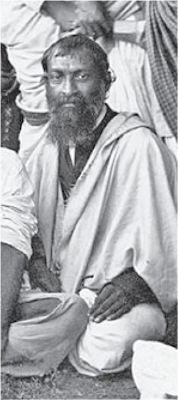
At top, that's Sri M some years after his master's death. Just above is the more classic shot of him in old age, sitting near the Panchavati at Dakshineswar. Here's a nice site devoted to Sri M's home, with some interesting photos.